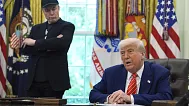
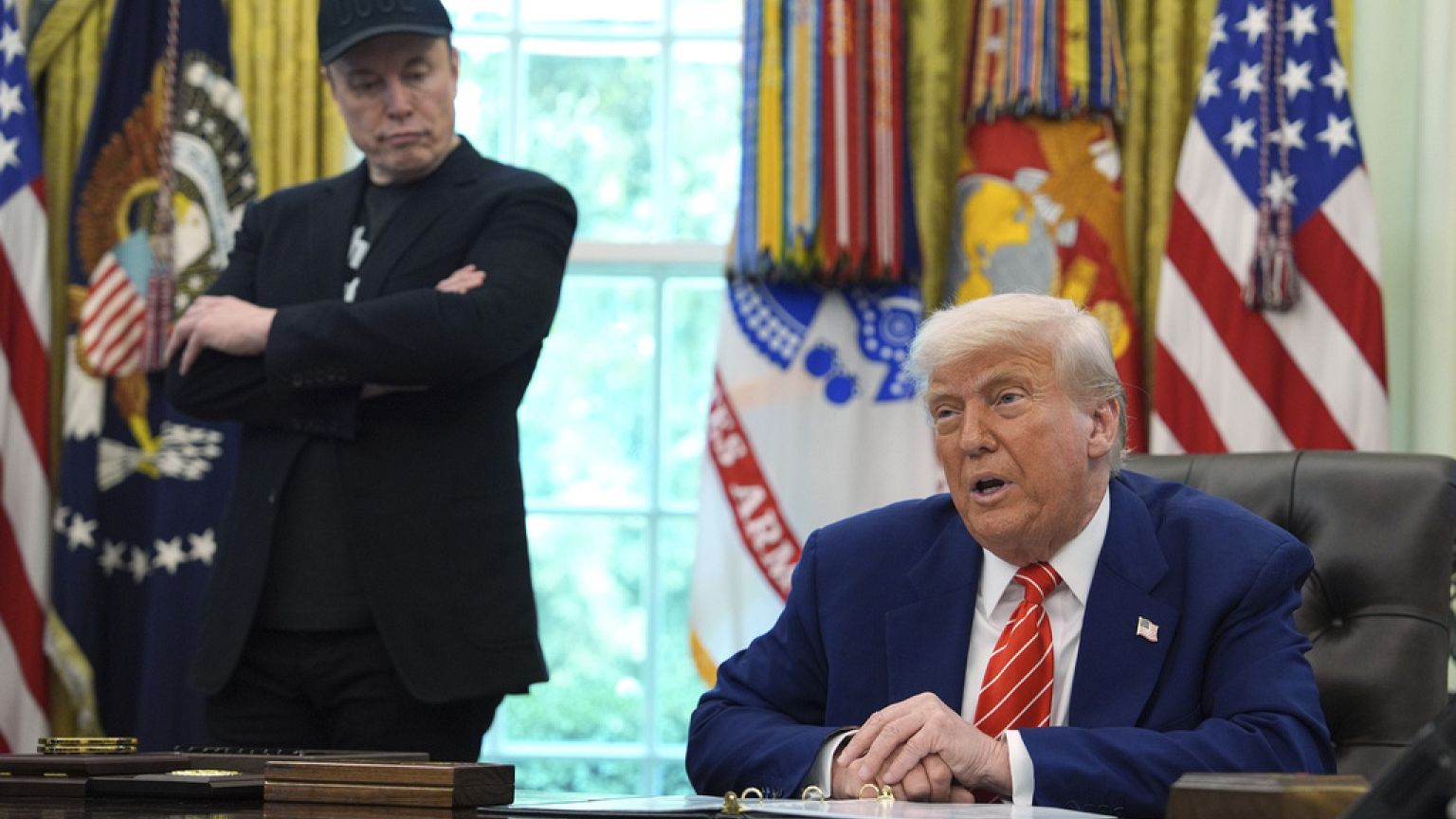
Musk, who wore all black, including a T-shirt that said “The Dogefather,” nodded along as the president listed contracts that had been cut under his watch.
US President Donald Trump bid farewell to Elon Musk in the Oval Office on Friday.
Musk is leaving his position spearheading the Department of Government Efficiency (DOGE) and is rededicating himself to his businesses, including electric car maker Tesla, rocket company SpaceX and social media platform X.
The US President credited Musk with “a colossal change in the old ways of doing business in Washington" and said some of his staff would remain in the administration.
Musk left a searing mark on the US federal bureaucracy, including thousands of employees who were fired or pushed out.
Some government functions were eviscerated, including the US Agency for International Development, which had provided a lifeline for impoverished people around the world.
Boston University researchers estimate that hundreds of thousands of people have already died as a result of the cuts.
Trump gifted Musk what appeared to be a gold-coloured key for his work for establishing DOGE, which sought to layoff federal workers and close government agencies to achieve cost savings.
Trump said that he would only bestow this gift to "very special people" and that it was a "presentation from our country."
In response, Musk said: "I hope to continue to provide advice whenever the president would like."
"I hope so," Trump cut in before Musk said he hopes to still achieve $1 trillion in federal spending cuts over time.
“He’s going to be back and forth, I imagine,” Trump said.
Trump noted that DOGE employees will remain embedded with government agencies and said the billionaire will probably want to keep tabs on “his baby.”
Macron warns US and the Indo-Pacific not to abandon Ukraine at the expense of focusing on China
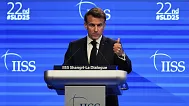
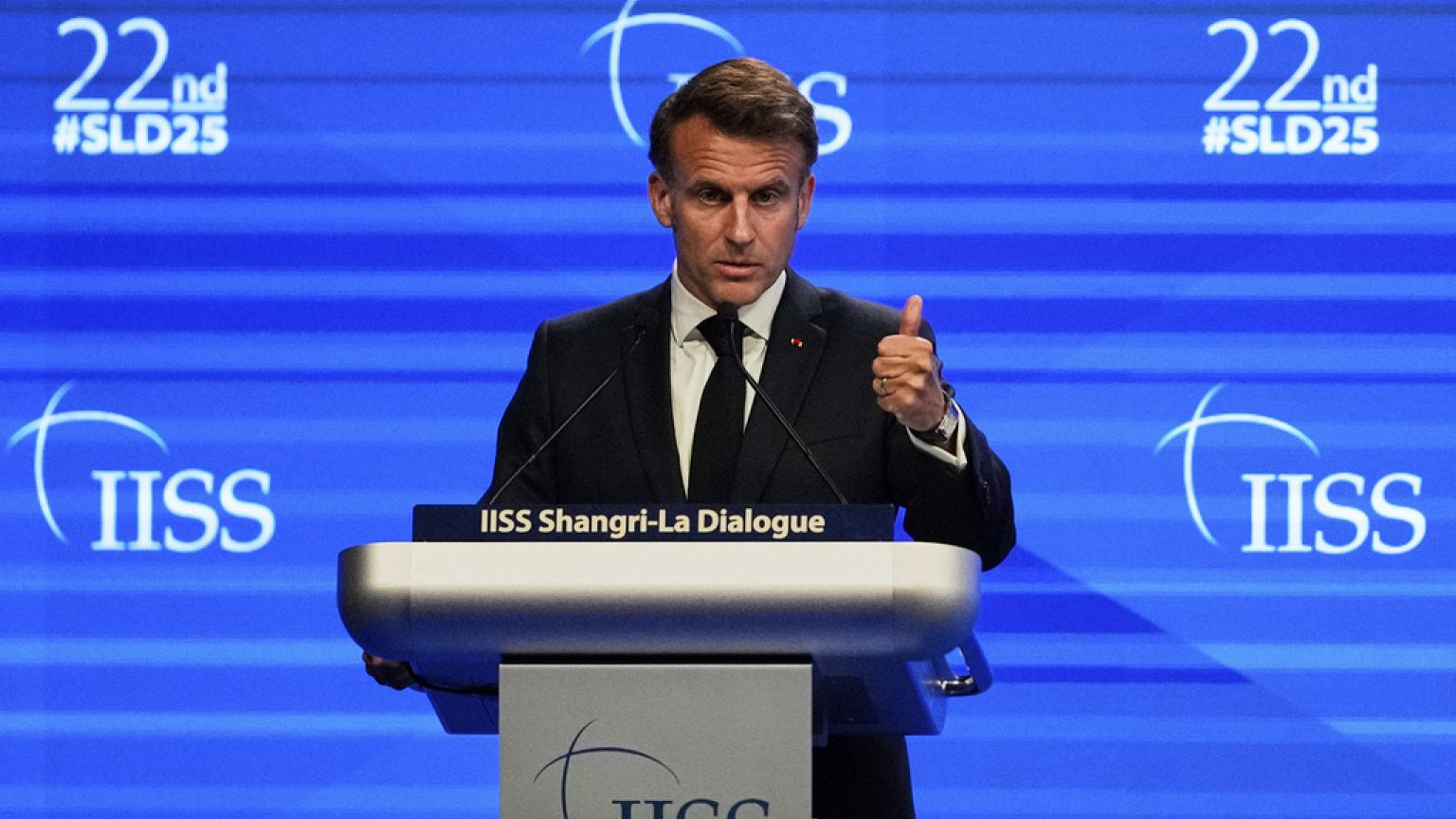
French President Emmanuel Macron delivers his speech during the 22nd Shangri-La Dialogue summit in Singapore, Friday, May 30, 2025.
- Copyright Anupam Nath/Copyright 2025 The AP. All rights reserved.
Copyright Anupam Nath/Copyright 2025 The AP. All rights reserved.
Copy/paste the article video embed link below:Copied
Macron said that any shifts to developing a more hard-line deterrent stance in the Indo-Pacific is still tied to how the world — and particularly the West — treats other critical issues.
ADVERTISEMENT
French President Emmanuel Macron warned the US and Indo-Pacific nations on Friday night that they risk a dangerous double standard as they concentrate on a potential conflict with China, if it comes at the cost of abandoning Ukraine.
Macron's remarks come as the US considers withdrawing troops from Europe to instead deploy in the Indo-Pacific. He warned abandoning Ukraine would threaten US credibility in deterring potential conflict between China and Taiwan.
"If you consider that Russia could be allowed to take a part of the territory of Ukraine without any restriction, without any constraint, without any reaction of the global order, how would you phrase what would happen in Taiwan, what would you do the day something happened?” he asked in a speech.
Macron's comments were made during his keynote address at Shangri-La Dialogue security conference in Singapore.
Settings
More
Settings
Pause (SPACE)
Read More (Shift + O)
Quality
Connatix
V586508
Quality
360p
720p HD
1080p HD
Auto
00:00
02:00
360p
720p HD
1080p HD
Auto
00:00
02:00
360p
720p HD
1080p HD
Auto
Connatix
V586508
Read More
1/1Skip AdContinue watchingafter the adVisit Advertiser websiteGO TO PAGE
It is the region’s biggest security forum that comes amid concerns of China’s growing assertiveness and the global impact of Russia’s full-scale invasion of Ukraine.
Notable was the fact that it the speech was delivered with US Defence Secretary Pete Hegseth in the audience.
Rhetoric between Beijing and Washington is heightening. The US has threatened China with triple-digit tariffs. There is uncertainty in the region over the commitment of the US to Taiwanese security – which also faces possible 32% American tariffs.
China claims Taiwan as its own. Chinese President Xi Jinping hasn’t ruled out taking it by force. China regularly sends military aircraft and ships near Taiwan and currently has an aircraft carrier southeast of the island.
ADVERTISEMENT
The US has been pursuing a "free and open Indo-Pacific policy,” which includes regularly sailing warships through the Taiwan Strait and in the South China Sea.
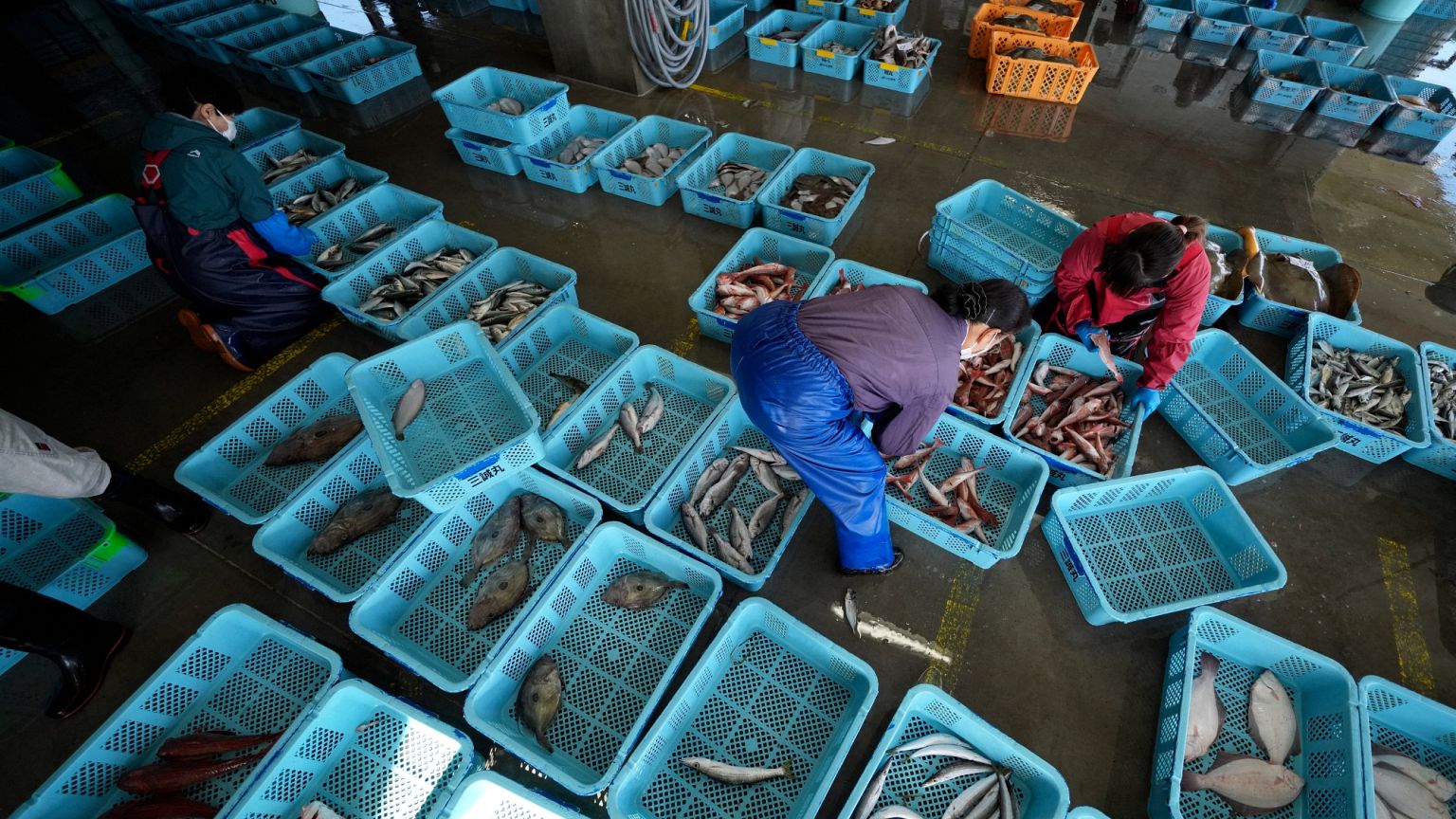
China blocked imports of Japanese seafood because it said the release of the treated and diluted but still slightly radioactive wastewater would endanger the fishing industry and coastal communities in eastern China.
China will resume seafood imports from Japan that it banned in 2023 over worries about the discharge of treated radioactive wastewater from the damaged Fukushima Daiichi nuclear power plant into the sea, a Japanese minister has said.
Agriculture Minister Shinjiro Koizumi said the agreement was reached after officials met in Beijing and the imports will resume once paperwork is complete.
China said talks this week made "substantial progress," but did not confirm an agreement with Japan on the issue that has been a significant political and diplomatic point of tension.
"Seafood is an important export item for Japan and a resumption of its export to China is a major milestone," Koizumi said.
Japan's Foreign Minister Takeshi Iwaya also welcomed the move, saying: "It will be a big first step that would help Japan and China to tackle a number of remaining issues between the two countries."
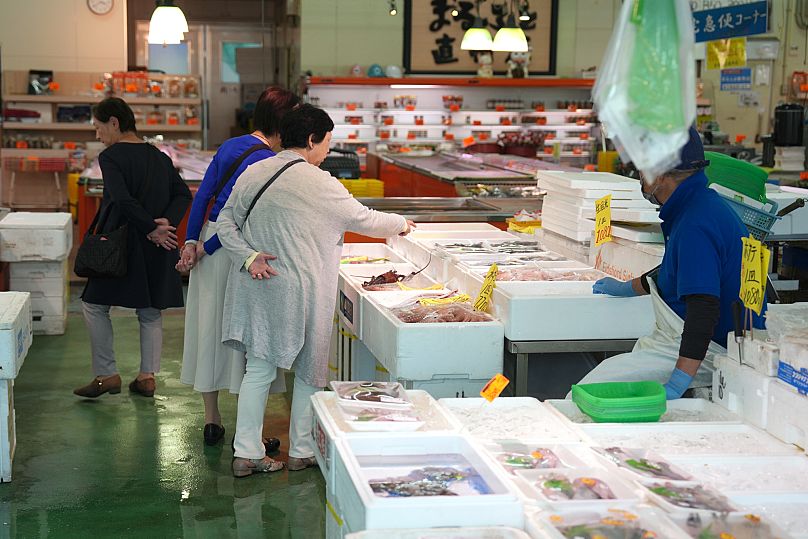
Visitors check seafood sold at the seafood market near the Onahama fish port in Iwaki City, 19 October, 2023 AP Photo
But officials said China's ban on farm and fisheries products from 10 Japanese prefectures, including Fukushima, is still in place and that they will keep pushing toward their lifting.
China's General Administration of Customs said in a statement that the two sides had held "a new round of technical exchanges on the safety issues of Japanese aquatic products...and achieved substantial progress," but did not mention any agreement.
Disagreement over seafood imports
China blocked imports of Japanese seafood because it said the release of the treated and diluted but still slightly radioactive wastewater would endanger the fishing industry and coastal communities in eastern China.
Japanese officials said the wastewater will be safer than international standards and its environmental impact will be negligible.
They said the wastewater must be released to make room for the nuclear plant’s decommissioning and to prevent accidental leaks.
Tokyo and Beijing have held three rounds of talks since March on the issue before reaching the agreement this week on the "technical requirements" necessary for Japanese seafood exports to China to restart, Japan's Foreign Ministry said in a statement.
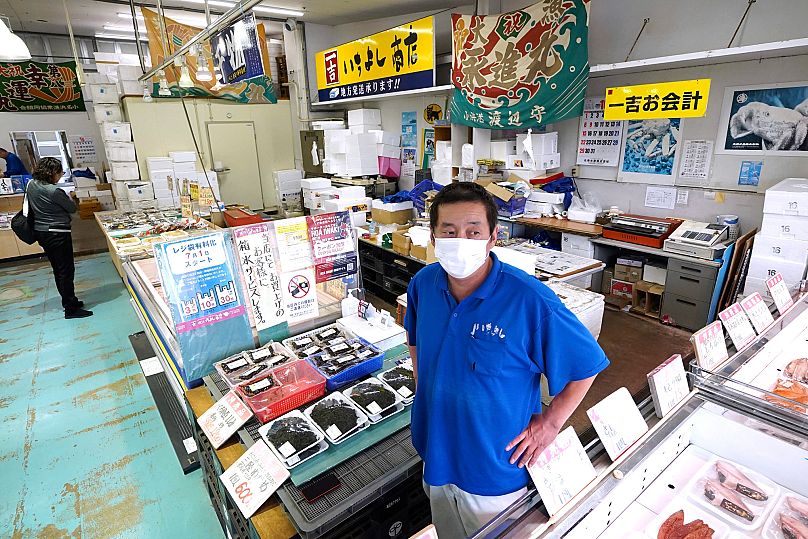
Ichiyoshi fish store manager Hiroharu Haga at the seafood market in Iwaki City, 19 October, 2023AP Photo
It did not say how long it may take before the actual resumption.
Mainland China used to be the biggest overseas market for Japanese seafood, accounting for more than one-fifth of its seafood exports, followed by Hong Kong.
The ban became a major blow to the fisheries industry, though the impact on overall trade was limited because seafood exports are a fraction of Japan’s total exports.
Japan’s government set up an emergency relief fund for its exporters, especially scallop growers, and sought alternative overseas markets.
Tokyo Electric Power Company Holdings, which operates the Fukushima Daiichi plant, has said it would compensate Japanese business owners appropriately for damages from export bans.
The nuclear power plant suffered meltdowns in three reactors after being heavily damaged in the 2011 earthquake and tsunami that struck northeastern Japan.
Water used to cool the reactor cores has been accumulating ever since and officials say the massive stockpile is hampering the cleanup of the site.
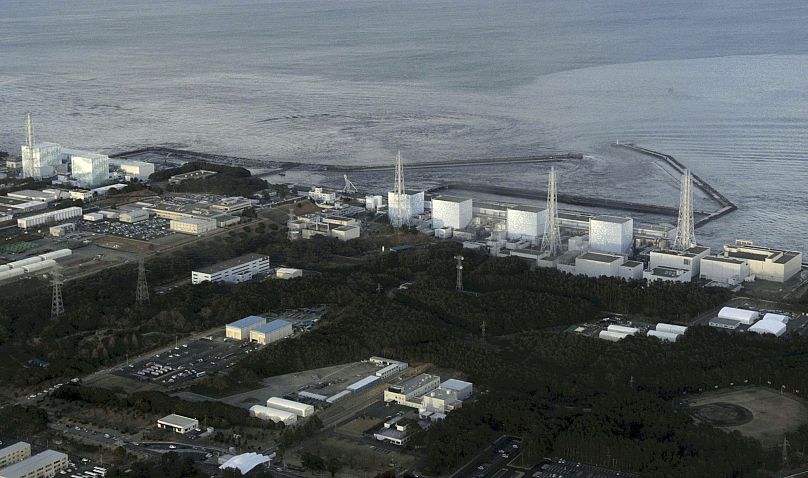
A photo taken around two hours after an earthquake and tsunami at the Fukushima Daiichi nuclear power station, 11 March, 2011AP Photo
The wastewater was treated and heavily diluted with seawater to reduce the radioactivity as much as possible before Japan began releasing it into the sea in August 2023.
People inside and outside Japan protested the initial wastewater release and Japanese fishing groups said they feared it would further damage the reputation of their seafood.
Groups in China and South Korea also raised concerns.